


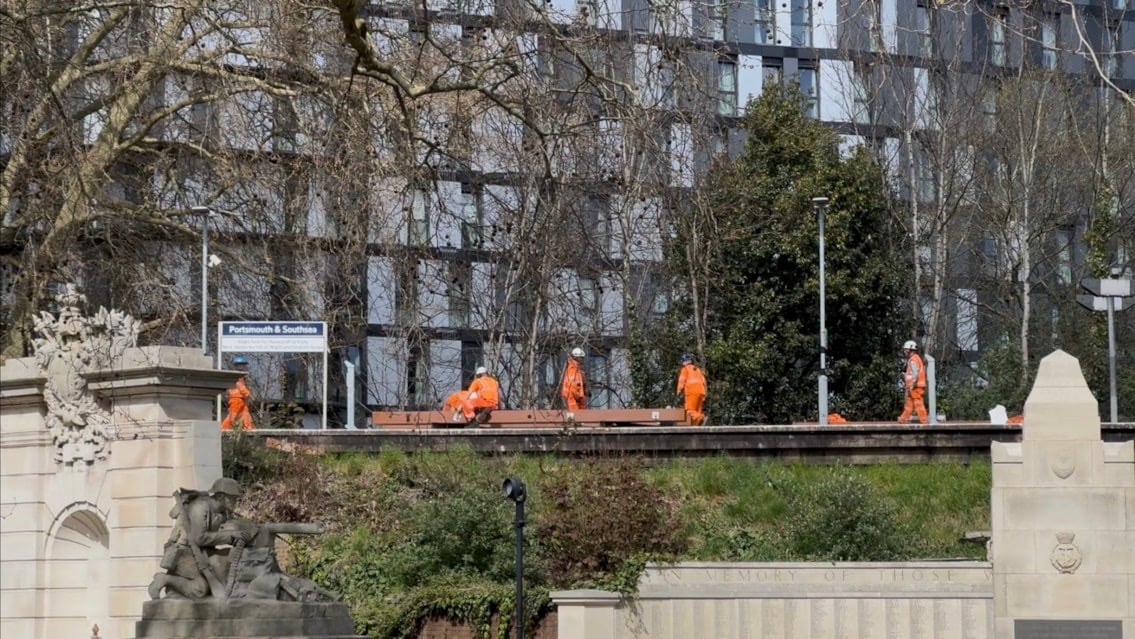
Train services to Portsmouth Harbour resumed this morning following a six-day closure that allowed engineers to complete essential maintenance work valued at £2 million, including structural repairs to a critical viaduct connecting the island city to the mainland. The Easter-timed reopening brings relief to thousands of daily commuters and marks progress in a broader modernisation programme that will continue disrupting services until at least 2028.
Network Rail and South Western Railway teams used the closure period between 28 March and 2 April to address deteriorating infrastructure south of Havant and Fareham, replacing ageing components and reinforcing structures that form vital links in Portsmouth’s connectivity to the national rail network. The work highlights ongoing challenges facing Britain’s Victorian-era railway infrastructure, where routine maintenance increasingly requires extended closures to prevent service failures.
“Smoother and More Reliable Journeys”
Tom McNamee, Infrastructure Director speaking on behalf of Network Rail and South Western Railway, emphasised the necessity of the disruption in securing long-term reliability. “We’d like to thank passengers for their patience and understanding while we carried out these vital improvements to the railway in Portsmouth,” he said. “By replacing aging assets and carrying out work on critical bridges and viaducts, passengers will benefit from smoother and more reliable journeys through the area.”
Mr McNamee also pointed to future benefits from the ongoing signalling upgrade programme, which utilised the closure period for surveys and analysis. “Once signalling upgrades are completed in 2028, passengers will profit from a railway that is more responsive, through integrated communication at the Basingstoke Rail Operating Centre,” he added.
Why This Matters
Portsmouth’s rail infrastructure carries significance beyond local commuter traffic. As a major naval base and ferry port with connections to the Isle of Wight and continental Europe, the city serves as a strategic transport hub where disruptions ripple across military, commercial and leisure travel. The structural repairs to Portcreek Viaduct proved particularly critical, as this bridge provides the sole rail connection between Portsmouth Island and the mainland.
The £2 million investment represents a relatively modest sum within the context of national rail spending, yet illustrates the persistent maintenance burden imposed by Britain’s historic infrastructure. Many of the components replaced during the closure, including wheel timbers that support tracks on bridges, date from previous decades and require periodic renewal to prevent catastrophic failures that would trigger far longer service interruptions.
The work also demonstrates the challenge of balancing maintenance needs against passenger convenience. A six-day closure during the Easter period inevitably affected holiday travel, yet scheduling such work during quieter periods would have prolonged the disruption or left critical infrastructure vulnerable for longer. Network Rail faces similar dilemmas across the network, where deferred maintenance risks compounding problems whilst timely intervention disrupts services.
What Happened
During the six-day closure, engineering teams executed a comprehensive programme of improvements across multiple locations. The most substantial element involved replacing 62 wheel timbers between Portsmouth & Southsea and Portsmouth Harbour stations. These long blocks of timber support railway tracks on bridges and require replacement when deterioration threatens structural integrity.
Structural repairs to Portcreek Viaduct formed another crucial component. This bridge, which carries the railway between the mainland and Portsmouth Island, underwent work to address underlying issues that could have compromised its long-term viability. The specific nature of the repairs was not detailed, though such interventions typically address concrete deterioration, metalwork corrosion or foundation settlement.
Engineers also conducted tamping work using specialised machinery that lifts and repositions track to ensure correct alignment. This process addresses track geometry issues that develop through regular use, improving ride quality and reducing wear on both rolling stock and infrastructure. Properly aligned track delivers smoother journeys and extends the intervals between future maintenance interventions.
Cable troughing between Farlington and Cosham received repairs designed to better protect signalling equipment and improve reliability. Exposed or damaged troughing leaves cables vulnerable to water ingress and physical damage, potentially triggering signal failures that halt services. The refurbished footbridge at Fratton station rounded out the improvement package, addressing passenger facilities alongside core infrastructure.
The Broader Modernisation Programme
The closure served dual purposes, combining immediate maintenance needs with preparatory work for a more extensive signalling upgrade scheduled for completion in 2028. Teams used the access opportunity to conduct surveys and analysis supporting this modernisation project, which will ultimately integrate the area into the Basingstoke Rail Operating Centre’s digital control systems.
Modern signalling systems replace mechanical and relay-based equipment with digital communications that allow more responsive train movements and improved capacity utilisation. The transition requires extensive groundwork including cable installation, equipment housing preparation and testing protocols that benefit from line closures already scheduled for other maintenance.
Network Rail has announced that further closures will follow, with the next planned between 25 and 29 May and an additional autumn closure yet to be detailed. This phased approach spreads disruption across multiple shorter periods rather than attempting a single extended shutdown, though passengers face recurring inconvenience as the programme advances.
What Happens Next
The May closure will likely address additional maintenance priorities identified through ongoing condition monitoring, whilst continuing the signalling upgrade preparations. Network Rail typically schedules such work during periods of lower demand, though the Easter timing of the recently completed closure suggests operational necessities sometimes override ideal scheduling preferences.
Passengers using services through Portsmouth should anticipate recurring disruptions through 2028 as both routine maintenance and the signalling modernisation programme progress. The extent to which these closures affect travel depends partly on replacement bus arrangements and whether alternative routes via Brighton or other connections provide viable options for specific journeys.
The signalling upgrade’s 2028 completion target places it within the medium-term horizon for infrastructure projects of this scale. Digital signalling installations require extensive testing and commissioning periods to ensure safety and reliability, meaning visible progress may appear gradual even as background work continues.
What This Means for the UK
Portsmouth’s experience reflects broader challenges facing Britain’s railway network, where infrastructure dating from the Victorian era requires constant renewal to maintain service standards. The Department for Transport and Network Rail face persistent tension between maintaining existing assets and funding new capacity enhancements, with limited budgets forcing difficult prioritisation decisions.
The £2 million Portsmouth investment represents routine maintenance rather than transformational improvement, yet even sustaining current service levels demands substantial ongoing expenditure. Deferred maintenance creates cascading problems where minor issues escalate into major failures requiring emergency interventions at greater cost and disruption.
The signalling modernisation component aligns with wider government priorities for railway digitalisation. Modern train control systems promise enhanced capacity, improved reliability and reduced operating costs, though the transition requires patient investment over extended periods. The 2028 completion target for Portsmouth’s upgrade illustrates the timescales involved in modernising critical infrastructure whilst maintaining active services.
For passengers, the Portsmouth work exemplifies the trade-off between short-term inconvenience and long-term reliability. Six-day closures test patience, particularly when travelling during holiday periods, yet prevent the prolonged disruptions and safety risks that deteriorating infrastructure would eventually trigger. Whether this balance satisfies public expectations depends partly on visible service improvements once work concludes.
Key Facts and Background
How long was the Portsmouth railway closed?
The line was closed for six days from Saturday 28 March to Thursday 2 April, reopening on Friday 3 April in time for Easter weekend travel.
What was the total cost of the improvement works?
Network Rail and South Western Railway invested £2 million in the various upgrades and repairs completed during the closure period.
What is Portcreek Viaduct and why is it important?
Portcreek Viaduct is the bridge that carries the railway between the mainland and Portsmouth Island, making it the sole rail connection to the city. Structural integrity of this bridge is essential for maintaining train services.
What are wheel timbers?
Wheel timbers are long blocks of timber that support railway tracks on bridges. They distribute the weight of trains across bridge structures and require periodic replacement as they deteriorate through use and weathering.
When is the signalling upgrade scheduled to complete?
The signalling modernisation programme is due to finish in 2028, with work continuing through multiple planned closures between now and then.
Are more closures planned?
Yes. The next closure is scheduled for Monday 25 to Friday 29 May, with a further closure planned for autumn. Additional closures will likely be announced as the signalling upgrade programme progresses toward its 2028 completion.
