


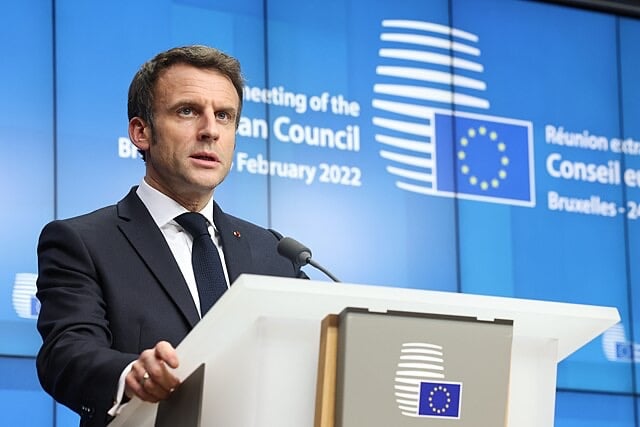
France is set to increase its nuclear warhead stockpile for the first time since the early 1990s and could station nuclear-capable aircraft on British soil, as President Emmanuel Macron unveiled what he described as a fundamental reshaping of France’s deterrence posture to meet growing threats across Europe and beyond.
Speaking from the Île Longue submarine base in Brittany — one of France’s most strategically sensitive military installations — Macron announced a policy of “advanced deterrence” that would allow French nuclear-armed jets to be temporarily deployed across a network of participating European nations, which he described as “an archipelago of force” designed to “complicate our adversaries’ calculations.”
Britain is among nine countries signed up to the arrangement, alongside Germany, Poland, the Netherlands, Belgium, Greece, Sweden and Denmark. The scheme builds directly on the Northwood cooperation agreement reached between Paris and London in July 2025, which established that while the two countries’ nuclear arsenals remain separate and independently controlled, they “can be coordinated.” Senior British defence officials participated in a French strategic air force exercise this winter — the first time they had done so — marking a concrete step toward deeper nuclear cooperation between Europe’s only two nuclear-armed states.
Macron confirmed that France would expand the size of its warhead stockpile, currently estimated at around 290, though he declined to specify the scale of the increase. “An upgrade of our arsenal is essential. That’s why I have decided to increase the number of warheads,” he said, while stressing that ultimate authority over France’s nuclear weapons would remain solely with the French president. “There will be no sharing of the ultimate decision, its planning, or its implementation,” he said.
Standing before one of France’s nuclear submarines, Macron underlined the scale of destructive power at France’s disposal, noting that a single missile from such a vessel carried more force than all conventional bombs dropped during the Second World War.
Beyond nuclear matters, Macron announced that France, Britain and Germany would jointly develop very long-range missile systems under an initiative known as the European Long-Range Strike Approach, or Elsa. The trilateral programme is described as a response to Russia’s expanding missile capabilities and the breakdown of international arms control frameworks. Macron characterised the current rules-based environment as “a field of ruins”, pointing to the collapse of the Intermediate-Range Nuclear Forces treaty and the expiry of the New START agreement between Washington and Moscow.
He also identified China’s growing nuclear capabilities and proliferation concerns surrounding Iran and North Korea as factors contributing to what he called a period “fraught with risk.”
A British government spokesman welcomed the announcement, confirming that concrete cooperation measures had been agreed through the Northwood Declaration and at last year’s UK-France summit. “The UK and France are both resolved to deter threats against Europe and will not be intimidated by Russian nuclear rhetoric,” the spokesman said.
The announcement also came as France pledged to deploy anti-missile and anti-drone systems to Cyprus, following drone attacks on RAF Akrotiri attributed to Iranian-made Shahed drones. Further details of how the advanced deterrence arrangements will be implemented across participating nations are expected to be set out in the coming months.
