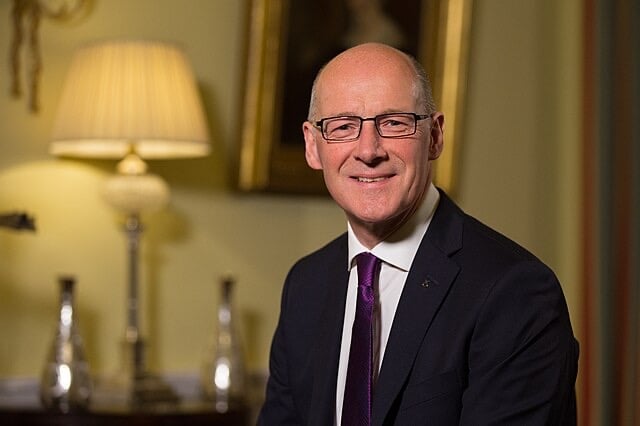
John Swinney knew two patients were being treated for fungal infections on a cancer ward contaminated by mould and water – but still told the public that Scotland’s £1billion superhospital was safe.
Mr Swinney and his Health Secretary Neil Gray also kept the two infections – and two other suspected cases – secret as a political storm erupted over conditions on Ward 4B at the scandal-hit Queen Elizabeth University Hospital (QEUH.)
Politicians branded Mr Swinney and Mr Gray’s actions a staggering ‘cover-up’ and ‘more secrecy’ and ‘lies’ from SNP ministers. New documents obtained by the Scottish Mail on Sunday reveal the First Minister and Mr Gray were told about two confirmed cases of hospital-acquired fungal infections on ward 4B at the Queen Elizabeth University Hospital (QEUH) on February 26.
At the time NHS Greater Glasgow and Clyde (NHSGGC) bosses were closing rooms on the ward, which deals with bone marrow transplant patients, due to reports of water leaks and concerns about mould.
Less than a week later, on March 4, while being questioned about the room closures, neither Mr Swinney nor Mr Gray mentioned infections. Instead both ministers insisted the hospital was safe.
Scottish Labour deputy leader Jackie Baillie said our revelations were ‘staggering’ and said: ‘It is absolutely outrageous that SNP ministers have continued to lie to journalists and MSPs about this.’
Documents obtained under Freedom of Information show reveal two patients were confirmed as having hospital-acquired fungus infections while being treated in ward 4B, and two others had ‘possible’ infections. The two confirmed cases were infections from fungi Exophiala dermatitidis and Mucor velutunosus.
One email, sent from the Scottish Government to NHSGGC chiefs on February 26 refers to a healthcare infection alert (HIIAT) and states: ‘The First Minister and Cabinet Secretary are urgently requesting some further information on the Amber HIIAT reported to us today’.
The email confirms the incident was related to ‘water ingress and cases of fungal infection in ward 4B in the QEUH’ and states: ‘Since February 1, 2026, there have been 2 microbiologically confirmed cases of fungal infection and two possible cases.’
A briefing sent to Mr Gray on March 2 gives details of the infections and states that swabs taken in one room, which had black marks on the ceiling, had been ‘negative’ but they would continue to swab and take air samples.
During First Minister’s questions on March 5, Mr Swinney was asked about ward 4B. He told parliamentarians: ‘It is important that I put that on the record that, fundamentally, the clinical consensus is that the wards in question are safe.’
Mr Gray confirmed to parliament on March 12 that mould had been grown from swabs taken on the ward but again did not mention patients’ infections.
He told MSPs: ‘Regarding media interest in potential mould and water ingress, Antimicrobial Resistance and Healthcare Associated Infection Scotland notified the Scottish Government of an incident of water ingress in ward 4B in the Queen Elizabeth university hospital on 26 February 2026. Ministers were made aware of that late in the afternoon on the same day.’
NHS bosses also failed to mention patient infections when quizzed by journalists. On March 7 our reporter asked the health board why they had issued a healthcare infection alert – known as a HIIAT – and whether any patients were infected. We received no response. Maureen Dynes’s husband Tony, 63, had lymphoma and was being treated on ward 4B. He died in 2021 after contracting two infections.
She said: ‘Since Tony’s death, the government and health board has told us time and again that the hospital is safe. Now we learn that patients are still getting these unusual fungal infections, in the same ward Tony was in, at the same time they are investigating problems with water and mould. History is repeating itself.
‘On top of this, we are having to learn through the media about these issues. Not once was there mention of patients being infected during all of this when the NHS and Scottish Government were questioned about it. So much for culture change and transparency.
‘I plead with the government and NHSGGC to take action now before more families suffer like mine has. This has to stop.’
Ms Baillie said: ‘After years of cover-up from SNP ministers about the QEUH, and the damage that has brought with it, anyone would think this government would have learned its lessons.
‘However, it appears that the SNP are continuing to take the same approach as they have for years – covering up serious issues and refusing to disclose crucial information to the public, even when asked directly about safety concerns.
‘Both NHSGGC and John Swinney insisted that the hospital was safe for patients, yet it appears that this was simply not the case. It is absolutely outrageous that SNP ministers have continued to lie to journalists and MSPs about this.
‘We urgently need straight answers from John Swinney and Neil Gray. We cannot afford more spin and deceit from this rotten SNP government.’
Scottish Tory health spokesman Dr Sandesh Gulhane said: ‘This is damning evidence of yet more secrecy and cover-up from SNP ministers. ‘They were fully aware more patients at this hospital had acquired infections and were clearly at risk but the public and Parliament were shamefully kept in the dark.
‘Whistleblowers are still telling us that this hospital is still unsafe for patients. John Swinney and Neil Gray cannot continue to hide behind an independent inquiry.
‘They must tell Scots the truth about what has gone badly wrong at the Queen Elizabeth University Hospital.’
NHSGGC did not explain why it had ignored our questions about patient infections but a spokeswoman claimed a statement on the board’s website ‘highlighted an Incident Management Team was established following the identification of an infection in a very small number of patients.’
She said NHSGGC ‘do not provide information on individual patients or small groups of patients when numbers are below five…to ensure patient information is kept confidential.
‘In the public statement we have explained key facts about the safety of Ward 4B and do not accept any suggestion there has been an attempt to minimise its seriousness.’
A Scottish Government spokeswoman said: ‘As Ministers have previously stated, they are deeply sorry for the issues patients have experienced at the QEUH and all that families have gone through.
‘The Scottish Government is in close contact with NHS GGC in relation to Ward 4B and receives regular updates to maintain an accurate picture of any ongoing developments.’
Trending
- German Men Must Seek Army Permission to Leave Country for Over Three Months Under New Rules
- John Swinney ‘Covered Up’ Fungal Infections on Cancer Ward Before Saying £1bn Superhospital Was Safe
- Rural Drivers Pay Premium at the Pump as Fuel Crisis Deepens Geographic Divide
- Portsmouth Rail Link Reopens After £2 Million Upgrade as Network Grapples with Ageing Infrastructure
- UK and France Dismantle £40 Million People Smuggling Ring Holding Migrants in Debt Bondage
- British Public Would Vote to Rejoin EU by Decisive Margin, Polling Reveals
- UK Refuses to Confirm US Alliance Status as Strait of Hormuz Crisis Deepens Diplomatic Rift
- British Marmalade Faces EU Rebrand Under Starmer’s Brexit Reset Deal


John Swinney ‘Covered Up’ Fungal Infections on Cancer Ward Before Saying £1bn Superhospital Was Safe
 By Ronan Walsh
©Wiki Commons

Ronan Walsh
Politics & Economy Ronan Walsh is a freelance journalist covering politics and the economy. He reports on UK and international political developments, public policy, and economic trends, with a focus on clarity, accountability, and real-world impact.
Add A Comment