


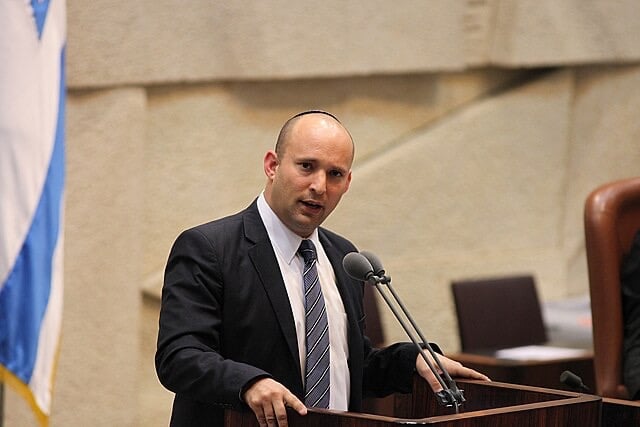
Senior Israeli politicians are increasingly positioning Turkiye as a major regional threat in language that analysts say mirrors how Israel has historically spoken about Iran, with former Prime Minister Naftali Bennett becoming the latest figure to demand action against Ankara alongside Tehran.
Speaking at a conference last week, Bennett declared that “a new Turkish threat is emerging” and accused Turkiye of forming part of a regional axis “similar to the Iranian one.” He called on Israel to act “simultaneously against the threat from Tehran and against the hostility from Ankara” — framing the two nations as twin dangers requiring parallel responses.
Bennett, who is widely expected to perform strongly in Israel’s upcoming elections, is not alone in the sentiment. Prime Minister Benjamin Netanyahu has separately announced plans for a new “hexagon” of international alliances designed to counter what he described as an “emerging radical Sunni axis” — a formulation that analysts say is partly aimed at Ankara — alongside the Shia axis Israel has long associated with Iran.
The shift in tone toward Turkiye comes as relations between the two countries have continued to deteriorate. Turkish President Recep Tayyip Erdogan has adopted an increasingly hostile stance toward Israel over its military operations in Gaza, and Turkiye has grown closer to regional powers including Saudi Arabia and Egypt. The suggestion of any Turkish role in Gaza’s proposed interim security arrangements has been described as politically toxic within Israel.
Yet analysts have pushed back sharply on attempts to cast Turkiye in the same mould as Iran. Former Israeli ambassador Alon Pinkas told Al Jazeera the comparison bordered on the absurd. “Israel has worked alongside Turkiye numerous times,” he said, recalling a period when Israeli policymakers spoke of the two nations as joint regional superpowers ranged against Iran. “And now they’re trying to supplant Iran with Turkiye? What are they talking about, armed conflict? Turkiye is a NATO power.”
Pinkas also challenged the ideological basis for the comparison. “Has the leadership in Turkiye ever denied Israel’s right to exist, or threatened to wipe it from the map? No. It’s ridiculous,” he said.
He further argued that the pattern of identifying new threats was a well-established feature of Israeli political life. “Politicians like Naftali Bennett and Benjamin Netanyahu rely on the perpetual threat of war,” Pinkas said. “If it wasn’t Turkiye, it would be Iraq. If it wasn’t Iraq, it would be Hezbollah. There just always needs to be a threat.”
Yossi Mekelberg of Chatham House echoed that assessment, suggesting the Turkish threat narrative was largely a distraction from the central issue of Iran. “Turkiye is just so much noise,” he said — though he cautioned that the rhetoric still carried real-world risks. Sustained hostile language toward Ankara, he warned, could ultimately turn a rhetorical rival into a genuine one.
Political analyst Ori Goldberg was equally sceptical of Netanyahu’s broader alliance-building push, describing it as “desperate” given that Israel had, in his words, “burnt through past alliances with Russia and now the United States.”
How far the Turkish threat narrative develops — and whether it translates into formal policy — is likely to become clearer as Israel’s election campaign progresses and Bennett’s platform takes shape in the coming months.
