


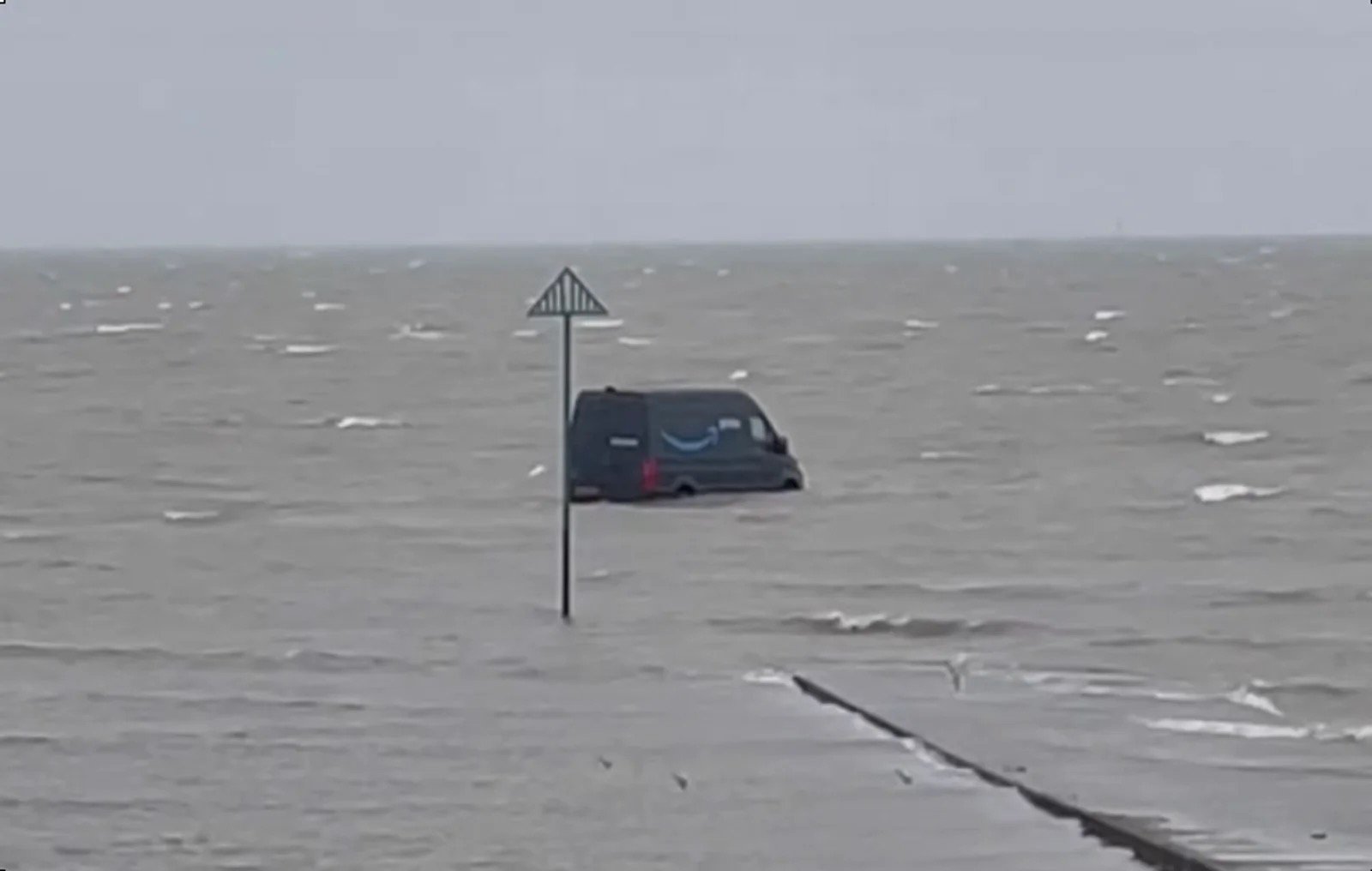
A 600-year-old walking path into the Thames Estuary dubbed “the deadliest path in Britain” has claimed its latest victim after an Amazon delivery van became trapped in rising waters following satnav directions.
The Broomway, a six-mile route crossing mudflats towards Foulness Island in Essex, is estimated to have claimed at least 100 lives over the centuries. Foulness churchyard contains 66 victims laid to rest, with many more having perished on the sands throughout history.
The ancient path is particularly treacherous because incoming tides move faster than most people can run, whilst swirling mists disorient those attempting to cross. It should only be traversed on foot with an experienced guide who knows the mudflats.
Modern markers no longer exist on the route. The “brooms” – bundles of sticks and twigs attached to poles that marked the way for centuries and gave The Broomway its name – have disappeared, leaving the path unclear to those unfamiliar with the terrain.
An unidentified Amazon driver followed GPS instructions across the walking path on Saturday night, travelling towards Foulness Island four miles from Southend. The route is wholly unsuitable for vehicles and requires specialist knowledge to navigate safely even on foot.
The driver abandoned the van in rising waters before removing themselves from the vehicle and reporting the incident to Amazon. The company arranged with a local farmer to extract the vehicle on Sunday, with HM Coastguard Southend confirming collection occurred at 3:30pm.
Foulness Island remains mostly closed to public access because the Ministry of Defence uses it for weapons testing. The area is only accessible when firing ranges are inactive and barriers are open. The correct vehicular route onto the island passes through a Qinetiq security office via a left barrier, not The Broomway.
HM Coastguard Southend stated: “The Broomway route is not for vehicles and should only be walked on with a guide who knows the mud flats. It is an extremely dangerous area and is on MOD property, only free to access when the firing ranges are not active and the barrier is open.”
QinetiQ, the global defence and security company managing The Broomway, describes it as a “unique right of way, which requires both caution and specialist knowledge to negotiate safely.”
The path served as the only crossing to Foulness Island before a bridge was constructed in the 20th century. Wakering Stairs marks the mainland starting point of The Broomway where the Amazon van entered the mudflats.
HM Coastguard Southend’s Duty Senior Officer spoke with the Qinetiq security officer on Sunday morning, who confirmed awareness of the van and that both passenger and driver had driven onto the mudflats the previous evening.
An Amazon spokesman confirmed the company is investigating the incident. The satnav malfunction represents the latest example of GPS technology directing drivers onto dangerous or unsuitable routes.
Similar hazardous causeways exist elsewhere in the UK. Lindisfarne, or Holy Island, off the northeast Northumberland coast becomes cut off from the mainland twice daily by fast-moving, high-tide waters. A three-mile causeway links the island to mainland village Beal, with visitors required to check official safe crossing times to avoid becoming stranded.
The incident raises questions about mapping data accuracy for restricted military areas and whether satnav systems adequately warn drivers about pedestrian-only routes or tidal hazards. The Broomway’s historical designation as a walking path appears not to have prevented its inclusion in vehicle routing systems.
Authorities have not disclosed whether the driver or Amazon face penalties for unauthorized access to MOD property or vehicle use on the restricted pathway.
